- Need immediate help?
- 1 (800)-631-5656
- help@nationalinjuryadvocates.com

Hidden Toxic Dangers for Railroad Workers Leads to Lawsuits
Social Media Addiction is Real and Only Getting Worse
March 11, 2022Similac Cronobacter Recall | Lawsuit Claims Starting
April 29, 2022
March 28, 2022 — San Diego, CA. Since the 1930’s major railroad companies across America have come under investigations for toxic hazards found in and around railroad yards, railway stations, storage facilities and other buildings used in most large railroads. In this article we’ll look at the most common types of toxic dangers and diseases facing railroad workers.
Because of the nature of heavy industries, including trains, many of these places are, or have been contaminated with one or more known carcinogens. However most of these large railroad companies haven’t taken action to protect and address the toxic hazards known to harm rail workers.
Get Your Free Railroad Injury Case Review
Tell Us About Your Railroad Injury or Illness
"*" indicates required fields

One major illness that has affected thousands of railroad workers is lung cancer from diesel exhaust fumes.
In a study published in November of 2004 by the Environmental Health Perspectives (EHP) titled Lung Cancer in Railroad Workers Exposed to Diesel Exhaust they assessed lung cancer mortality in 54,973 U.S. railroad workers between 1959 and 1996 (38 years).
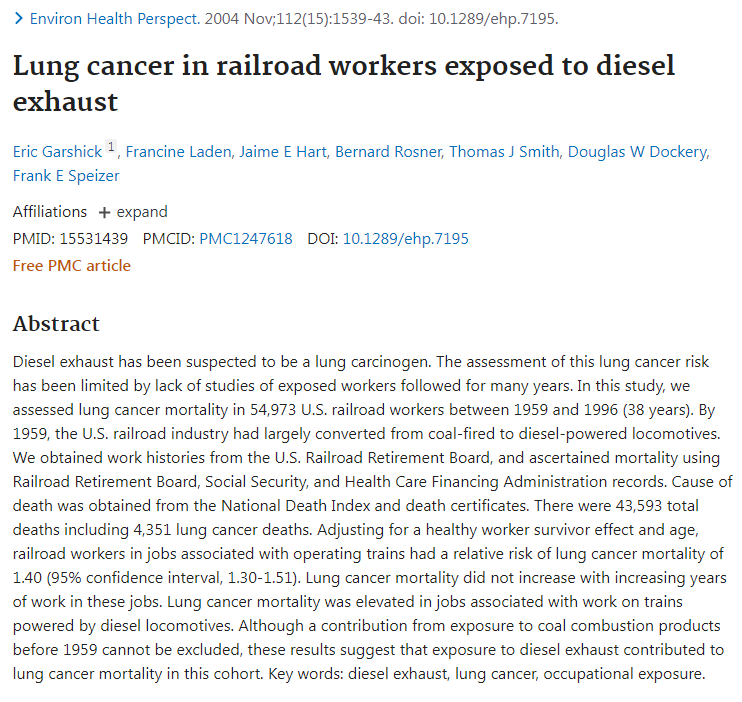
By 1959, the U.S. railroad industry had largely converted from coal-fired to diesel-powered locomotives. They obtained work histories from the U.S. Railroad Retirement Board, and ascertained mortality using Railroad Retirement Board, Social Security, and Health Care Financing Administration records. Cause of death was obtained from the National Death Index and death certificates. There were 43,593 total deaths including 4,351 lung cancer deaths.
Silica exposure is another major concern. According to the National Institute for Occupational Safety and Health (“NIOSH”) their investigators ruled that a health hazard existed for railroad track maintenance workers from occupational exposure to crystalline silica. Silica is found in gravel and clay products used as railway tie ballast. The known health risks associated with silica exposure includes: Silicosis, lung cancer, chronic obstructive pulmonary disease, and kidney disease.
Asbestos exposure is fairly common in and around railroads due to the product being used for the trains brake shoes, gaskets, seals, clutch plates and gears. When these parts are changed out for maintenance particles can become airborne and even with short term exposure, asbestos fibers can enter the lungs and leads to a fatal lung disease called mesothelioma. Sadly there is no known cure for mesothelioma.
Creosote exposure happens during routine maintenance of rail lines when the wooden ties are changed out. Creosote, a distillate of tar, is used to treat wood ties and acts as a preservative. Coming into direct contact can cause burns to the skin, if inhaled leads to respiratory issues and kidney or liver problems.
Benzene exposure can happen to railroad workers at a few different points, but mainly from its use in diesel fuels where workers can breathe in the exhaust fumes. Benzene is used to produce numerous products including plastics, lubricants, rubber items, drugs and pesticides. Benzene is listed as a chemical known to cause cancer. Benzene causes acute myeloid leukemia (acute non-lymphocytic leukemia), and there is limited evidence that benzene may also cause acute and chronic lymphocytic leukemia, non-Hodgkin’s lymphoma and multiple myeloma.
Roundup spray exposure. The use of Roundup (Glyphosate) spray for railroad track right of way vegetation management has been documented since the late 1970s. It was used on hundreds of thousands of railroad track miles across the U.S. Roundup has been in the legal spotlight for years and is facing hundreds of thousands of non-hodgkin’s lymphoma cancer lawsuits. Bayer AG has offered to pay $8 billion to settle cancer claims.
Major railroad companies in the U.S. hire thousands of people; BNSF alone has 35,000 employees and has $29 billion in revenue. Union Pacific has 31,000 employees and has $19.53 billion in revenue. CSX Transportation has 25,000 employees and earned $10.6 billion in revenue.
Despite the number of people employed and billions in profit, these companies have fallen short in taking preventive measures to protect their workers. Unfortunately many if not all of these occupational cancers could have been prevented if the railroad companies would work with our government officials and adhere to safety regulations that are currently in place.
If you or someone you know or love has been diagnosed with any form of cancer and has worked for the railroads, in any job capacity, we will take action against the rail company failing to protect their most valuable asset – their workers.
Please use our 100% secure intake evaluation form to start your compensation claim, or simply call us toll free at 1-800-631-5656. Take action for you or your family member.
Sources: