- Need immediate help?
- 1 (800)-631-5656
- help@nationalinjuryadvocates.com

Xeljanz Linked to Deadly Blood Clots
Onglyza and Kombiglyze linked to heart failure in diabetes patients
November 7, 2018Valsartan, Losartan & Irbesartan Recalled Due to Cancer Risk
March 11, 2019FDA Warning: Xeljanz 10mg Not Approved for RA Patients & Linked to Deadly Blood Clots
Xeljanz blood clot risks are prompting lawsuits in all 50 states and in Canada, this is an ongoing class action lawsuit.
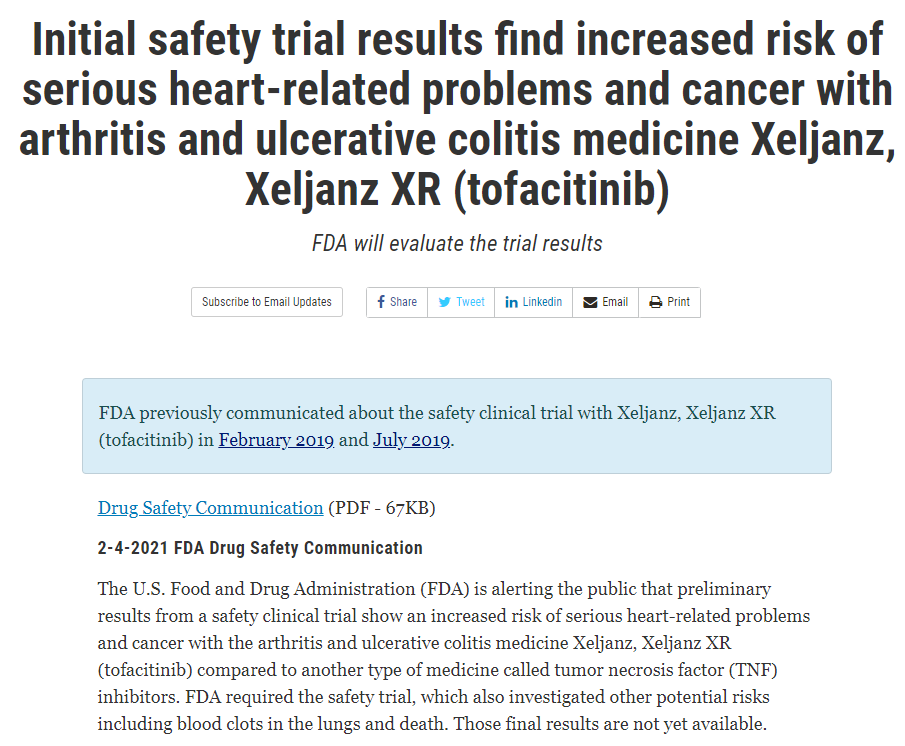
FDA Alert for Xeljanz issued. “Initial safety trial results find increased risk of serious heart-related problems and cancer with arthritis and ulcerative colitis medicine Xeljanz, Xeljanz XR (tofacitinib)”
The FDA is once again issuing a safety warning for those taking high doses of the medication Xeljance and Xeljanz XR. In this drugs clinical trial showed an increase of heart related problems and cancer.
This is the third time that the FDA has issued concerns over this drug used to treat arthritis and ulcerative colitis, the first drug safety warning was on February, 2019. This drug has an FDA Black-Box Warning – the highest level warning from the FDA.
Health Canada in May of 2021 issued its own warning to all Canadians from the Health Canada’s web site:
“Health Canada is conducting a safety review of Xeljanz and Xeljanz XR (tofacitinib) after a clinical trial identified an increased risk of serious heart-related issues and cancer in trial participants. The clinical trial investigated the long-term safety of Xeljanz and Xeljanz XR at 2 doses (5 mg twice a day and 10 mg twice a day) in patients with rheumatoid arthritis, who were at least 50 years of age and had at least one cardiovascular risk factor. Health Canada is working with the manufacturer to evaluate the available safety information and will inform the public of any new safety findings once the review is completed.”
Xeljanz was approved by the U.S. Food and Drug Administration (FDA) to treat people with rheumatoid arthritis (RA), who didn’t respond well to traditional RA treatments. The first drug of its kind on the market, Xeljanz was touted as an easy-to-take treatment for patients suffering from the painful effects of RA.
Since its release to the market, Xeljanz has been associated with serious adverse effects, including the risk of deadly infections and even cancer. Now, the FDA is warning about an increased risk of blood clots in the lungs and death when taking a high dose of Xeljanz. Patients taking the drug should be aware of these risks and talk with their doctors if they believe they are at increased risk for side effects.
Did you suffer side effects while on Xeljanz?
"*" indicates required fields
FDA Warns About Blood Clot Risk and Death with Xeljanz

The FDA issued a drug safety warning on Feb. 25 alerting patients that an ongoing clinical trial found an increased risk for blood clots in the lungs in people with rheumatoid arthritis taking 10 mg of Xeljanz twice a day. The increased risk for blood clots also put those patients at an increased risk of death.
The clinical trial in question was required by the FDA when it approved Xeljanz for rheumatoid arthritis. Currently, Xeljanz is not approved for people with RA at the 10 mg twice daily dose; that dosage is only approved for patients with ulcerative colitis.
Pfizer is transitioning RA patients off of the high dosage and onto a lower dose of 5 mg twice daily while the trial continues, according to the FDA. The trial is set to be completed by the end of 2019.
With concerns about the high dosage for RA patients, it is unclear what this could mean for patients with ulcerative colitis. In its safety communication, the FDA said it will continue to review safety information for Xeljanz.
“We are working with the manufacturer to evaluate other currently available safety information for tofacitinib and will update the public with any new information based on our ongoing review,” the agency said.

What Does This Mean for Patients?
Patients currently taking Xeljanz for rheumatoid arthritis should not change their dose or stop taking their medication before speaking with their doctor, the FDA says, as doing so could worsen their condition. Patients who are concerned about blood clots should talk to their doctor about their potential risks.
Patients with ulcerative colitis who are worried about the potential increased risk for blood clots in the lungs should also consult their doctors before stopping or changing treatment with Xeljanz.
The FDA is urging healthcare professionals to monitor their patients for signs and symptoms of pulmonary embolism, or blood clots in the lungs, including:
- Sudden shortness of breath or difficulty breathing
- Chest pain or pain in your back
- Coughing up blood
- Excessive sweating
- Clammy or bluish colored skin
About the Clinical Trial
When the FDA approved Xeljanz in 2012, the agency required the manufacturer to continue evaluating the safety of its new drug. Pfizer initiated a clinical trial involving patients taking Xeljanz for rheumatoid arthritis.
The trial was meant to evaluate the risk of heart-related events, cancer, and infections with Xeljanz in comparison to another drug called a TNF inhibitor. Xeljanz patients were given either 10 mg twice daily or 5 mg twice daily in combination with methotrexate. Patients in the trial were 50 years of age or older and had at least one cardiovascular risk factor.
Before the trial was scheduled to be completed at the end of 2019, the FDA reported some concerning findings. A recent analysis of the data found an increased risk for blood clots in the lungs, also called pulmonary embolism, and death in patients taking the higher 10 mg dose compared to those taking 5 mg or a TNF inhibitor. The report came from an external data safety monitoring committee.
Report Xeljanz Blood Clots and Other Adverse Side Effects
The FDA encourages patients to report adverse drug side effects. The FDA tracks these safety issues and uses them to make recommendations, take action, and improve the quality and safety of drugs and other products.
To report an adverse side effect to the FDA, visit the MedWatch Voluntary Reporting Form website or follow this link directly to form.
What is Xeljanz?

Xeljanz is a first-in-its-class medication approved by the FDA in 2012 to treat patients with rheumatoid arthritis who tried the medicine methotrexate and found it did not work for them. Xeljanz, also known by its chemical name tofacitinib, is a Janus kinase inhibitor manufactured by pharmaceutical giant Pfizer.
Xeljanz works by decreasing immune system activity. In RA, the body attacks its own joints, causing painful swelling and loss of function. Xeljanz blocks the action of enzymes called Janus kinases, which play a role in the inflammation caused by RA.
In 2017, five years after the drug was initially approved, the FDA signed off on a second use for the drug: treating patients with psoriatic arthritis who did not respond well to methotrexate or similar medications. Like RA, psoriatic arthritis is a condition that causes pain and swelling in the joints. In 2018, the FDA approved Xeljanz to treat ulcerative colitis, a chronic inflammatory bowel disease that affects the colon.
Xeljanz is a pill taken orally, usually twice a day and sometimes in combination with other drugs. The most common dosages of Xeljanz are 5 mg and 10 mg.
Xeljanz’s Black Box Warning
Xeljanz carries a black box warning—the FDA’s strongest warning short of a drug recall—over risks of serious infection and cancer. The warning states Xeljanz can cause serious infections that can result in hospitalization or death, including tuberculosis (TB), and bacterial, fungal, viral infections. The warning also states lymphoma and other malignancies (cancers) have been reported in patients taking Xeljanz.
Boxed warnings are the strictest warnings put on drug labels by the FDA and are meant to call attention to serious or life-threatening risks. Boxed warnings are the last line of defense before pulling a drug from the market entirely.
Other Potential Xeljanz Side Effects
Like all drugs, Xeljanz carries the risk of potential side effects, some of which can be serious and life-threatening. The risk of side effects can also depend on the type of disease a patient is taking Xeljanz to treat. The risk of blood clots with Xeljanz is just one potential side effect.
The most common side effects of Xeljanz include:
- Upper respiratory tract infection
- Nasopharyngitis (a common throat disease caused by inflammation of the pharynx and nasal cavities)
- Diarrhea
- Headache
- Rash
- Shingles
- Elevated cholesterol levels
Other potential serious side effects of RA and PA patients include:
- Serious infections
- Cancer
- Blood clots
- Heart attack
- Stroke
- DVT (deep vein thrombosis)
- PE (pulmonary embolism)
- Death
Xeljanz Initially Rejected in Europe
Xeljanz was approved by the FDA in 2012, but the European Medicines Agency, Europe’s equivalent to the FDA, rejected the drug over safety concerns at first. The agency said studies did not show a significant benefit over other RA drugs and that the risk of serious side effects did not outweigh the potential benefits.
In 2017, however, the EMA reversed course and approved Xeljanz for use in adults with rheumatoid arthritis, psoriatic arthritis, and ulcerative colitis. The agency cited several studies that showed the drug was effective in treating patients who did not respond to other treatments.
“The most important side effect seen with the medicine is infection and there are specific recommendations to help healthcare professionals reduce this risk. In general, the risks with Xeljanz were similar to those of other medicines of its class. The European Medicines Agency therefore concluded that Xeljanz’s benefits are greater than its risks and it can be authorised for use in the EU,” wrote the agency in overview of the drug.
The agency cited other serious potential side effects related to the drug in addition to infection, including liver damage, gastrointestinal bleeding, increased blood pressure and cholesterol, and increased risk of cancer.
As of March 6, the european agency had not yet released an update about Xeljanz following the FDA’s safety communication on Feb. 25. It is unclear whether or not the organization will issue updated recommendations about the drug in light of recent trial data showing an increased risk for pulmonary embolism in certain patients.
MAY 17, 2019: The European Medicines Agency announced restrictions on the use of Xeljanz in light of blood clots risks associated with the drug. The agency said doctors should not prescribe the 10 mg, twice a day dose of Xeljanz to patient at risk for blood clots. It also said doctors should consider blood clot risk factors when prescribing any dose of Xeljanz.
In a press release, the agency said the restrictions were necessary while it continued to study the safety of Xeljanz:
EMA’s safety committee (PRAC) is recommending that doctors must not prescribe the 10 mg twice daily dose of Xeljanz (tofacitinib) in patients who are at high risk of blood clots in the lungs. These include patients who have heart failure, cancer, inherited blood clotting disorders or a history of blood clots, as well as patients who take combined hormonal contraceptives, are receiving hormone replacement therapy or are undergoing major surgery.
In addition, doctors should consider other factors that may increase the risk of blood clots in the lungs including age, obesity, smoking or immobilisation.
Sources
FDA: “Safety trial finds risk of blood clots in the lungs and death with higher dose of tofacitinib (Xeljanz, Xeljanz XR) in rheumatoid arthritis patients; FDA to investigate.” Published February 2019. Accessed March 2019: https://www.fda.gov/Drugs/DrugSafety/ucm631871.htm
Xeljanz label: http://labeling.pfizer.com/ShowLabeling.aspx?id=959#S6.1
Healthline: “Xeljanz: A Blessing or a Curse for Rheumatoid Arthritis Patients?” by Ashley Boynes-Shuck. Published October 2014. Accessed March 2019: https://www.healthline.com/health-news/xeljanz-blessing-or-curse-for-ra-patients-100414#1
European Medicines Agency: “Xeljanz (tofacitinib).” Published 2018. Accessed March 2019: https://www.ema.europa.eu/en/documents/overview/xeljanz-epar-medicine-overview_en.pdf
European Medicines Agency: “Restrictions in use of Xeljanz while EMA reviews risk of blood clots in lungs.” Published May 2019. Accessed July 2019: https://www.ema.europa.eu/en/news/restrictions-use-xeljanz-while-ema-reviews-risk-blood-clots-lungs
Xeljanz Warning page updated on August 31, 2021 to include Health Canada Xeljanz public warning.